Oleg MelnikovYouTube
free resource

Claude Code for marketing (SMM, ads, outreach)

Five real marketing use cases with Claude Code: Instagram reels, competitor analysis, ad campaigns, cold outreach, and content creation. One walkthrough, all the systems Oleg actually uses.

Jump to the setup steps or read the whole thing in writing.

32K views7:16 longPublished Mar 2026

Setup guide

Download and install VS Code from code.visualstudio.com.

This is where you'll run Claude Code and build your marketing workflows.

The idea: one workspace that knows your business

One folder that holds who you are, who you sell to and what you look like, so every marketing task starts from your business instead of from nothing.

The mistake I see people make with AI and marketing is treating every task as a fresh conversation. You explain your company again, paste your brand colours again, describe your audience again, and you get a competent generic answer again.

This is the opposite. You build one folder that knows what your business is, what it looks like and who it sells to, and every task after that starts from there. The setup is ten minutes and it is the whole difference.

The example I used is a real estate company in dubai, but nothing here is specific to property. Swap the website and the reference screenshots and the same five things run.

The five things I actually ran

One prompt each. The whole set cost about three dollars of API credit.

  1. An on-brand Instagram reel, generated end to end. Not a script, the finished video, in the company's visual style. Which means you can produce as many as you want, for the feed or for ads.
  2. Competitor reels, scraped and turned into concepts. Ten trending reels in the niche, about seven million views between them, analysed for what they were doing, then new scripts written for us. The deeper version of this is The reels system.
  3. A trending podcast, turned into five posts. It found a two-hour real estate podcast with over 100,000 views, pulled the ideas out, and wrote five posts with visuals, ready for LinkedIn or Instagram. The prompt was three sentences.
  4. 100 outreach leads with personalised openers. Name, niche, LinkedIn URL and a first message written for that specific person. The serious version of this is The b2b outreach system.
  5. Competitor ads, analysed. The one I would start with. More on that below.

Why the ads one is the best first task

Facebook's ad library is public, and it shows how long each ad has been running. An ad that has been live for four years is an ad that is making money. Nobody publishes their conversion rates, but everybody publishes this, and it is the same information wearing a disguise. One prompt gets you every competitor's longest-running ads, what they have in common, and new concepts built on the pattern.

The two APIs that do the heavy lifting
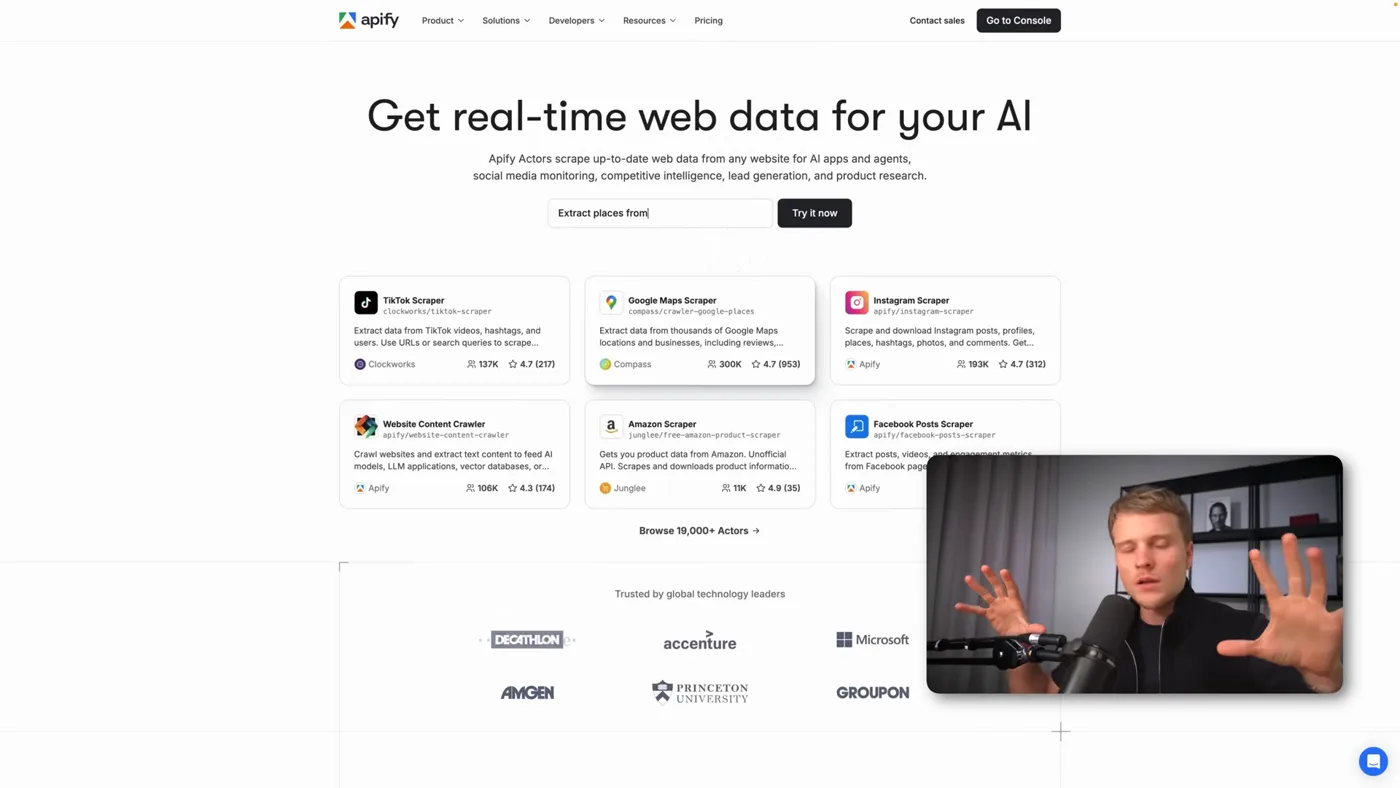
One key here unlocks Instagram, Facebook ads, Google Trends, YouTube and LinkedIn in the same workspace.
Apify
Everything that involves reading other people's data: Instagram, facebook ads, Google trends, YouTube, LinkedIn. Never try to scrape these yourself.
An image and video model
I use kie.ai, one key for several generation models, so the workspace can output the finished asset rather than a description of it.
Claude itself
Your $20 plan. The thinking, the writing and the code are all included.

That is the entire stack. Two keys in a .env file. The reason it is so small is that Claude Code writes whatever glue is needed between them, per task, rather than you assembling a pipeline in advance.

Setting the project up so it knows who you are

  1. 1Make a folder and start Claude Code in it

    Make an empty folder named after the business, open it, and run claude. That is the whole project. There is no scaffolding to download and nothing to configure yet.

  2. 2Give it the website and let it learn the business

    The first prompt is not a task, it is an induction. Give it the URL and ask it to work out what the company sells, to whom, and what the marketing is trying to achieve, then write that down.

    here is our website: ellingtonproperties.ae
    
    read it and work out what this business is, who it sells to,
    and how it talks. write what you learn into CLAUDE.md.
    
    the point of this project is to get more leads through marketing.

    Everything after this is better because of it. Without it you re-brief the model on every single task, and it shows in the output.

  3. 3Show it what the brand looks like

    This is the step that separates output you can post from output you delete. Make a reference/ folder and drop in four or five screenshots of your own Instagram grid.

    Not a brand guideline document. Screenshots. The model is looking at the images, and "this is the vibe" communicates faster through four pictures than through a page of adjectives about your brand.

  4. 4Connect Apify for anything that involves other people's data

    Apify is a marketplace of scrapers: instagram posts, facebook ads, google trends, youtube, linkedin. get an API token from settings and put it in .env.

    The mistake that wastes an afternoon

    Never ask Claude Code to scrape a site directly. It will try, it will half work, and you will spend an hour debugging something that was never going to hold. These platforms fight scraping. Apify maintains scrapers that keep working. Use them.

  5. 5Connect an image and video model

    Claude writes the concept and the script. It does not draw. For the visuals I use kie.ai, which is one key for several image and video models, so the workspace can produce the finished asset rather than a description of one.

    APIFY_API_KEY=...
    KIE_AI_API_KEY=...
  6. 6Ask for the output as a web page, not a chat reply

    The last line of every prompt I write is some version of "output all of it as a single HTML page in our style".

    A wall of terminal text is technically the same information and practically useless. A page you can scroll, with the videos embedded and the numbers laid out, is something you will actually read and can send to someone else.

The prompts, in full

These are close to what I actually said, dictated rather than typed. They are long, and that is the point: the context is the work.

Competitor ad analysis:

do a competitor analysis on facebook ads.

scrape the top ads from real estate brokers in dubai.
focus on legitimate companies, and on ads that have been
running for a long time, because that is the signal.

look at what the hooks have in common.
then generate five new creatives for us.

output all of it as one html page, in our style.

Podcast to posts:

find a recent, well performing podcast episode about
the dubai real estate market.

pull out the five most interesting ideas in it,
and write a social post for each one, with a visual.

output as an html page in our style.

The shape is always the same: A source, a judgement, an output format. Where to look, what counts as good, and what you want back.

What it costs

Claude plan
Pro, $20 a month
All five tasks above
About $3 of API credit, in total
Apify
$5 of free credit a month, then pay as you go
Image and video generation
Pay per generation, cents per image
What i spend
A few hundred a month on Apify, but that is daily client work, not trying this out

The cheap part is the thinking. The cost is scraping and generating pixels.

Where it falls over

  • Direct scraping. Covered above and worth repeating, because it is the single most common way to lose an afternoon.
  • A project with no context. Skip the website and the screenshots and everything it makes is generic. It will still be fluent, which makes it worse, because fluent generic is harder to notice.
  • Asking for five things in one prompt. One task per run. The results are better and you can see which part went wrong.
  • Trusting the first ad analysis. Ad longevity is a strong signal, not proof. A big company can run a bad ad for years out of inertia.
  • Publishing without reading. Everything here is a first draft with good bones. Your name goes on it.

If you have not set Claude Code up yet, do that first on The setup guide. What it all costs in total is on The pricing page.

If you get stuck

The things that actually go wrong, taken from the questions people ask under the video.

The terminal says “command not found: claude”

Installing the Claude Code extension in VS Code does not give you the Claude terminal command. The extension keeps a private copy for its own chat panel. That catches almost everyone, and it is not a broken setup.

To get the command, install Claude Code itself:

# macOS or Linux
curl -fsSL https://claude.ai/install.sh | bash

# Windows PowerShell
irm https://claude.ai/install.ps1 | iex

Then close the terminal window completely and open a new one. Skipping that is the second most common reason it still says not found. Check it worked with Claude --version.

Still not found on a Mac? Your PATH is missing the folder, so run these two lines:

echo 'export PATH="$HOME/.local/bin:$PATH"' >> ~/.zshrc
source ~/.zshrc

Claude doctor prints a full health report if you are still stuck. And if you would rather never touch a terminal, the Claude Code desktop app does the same job with buttons.

One thing worth knowing before you install anything: Claude Code needs a paid Claude plan (Pro or higher) or an API account. The free claude.ai plan does not include it, so it can install perfectly and still refuse to sign you in.

I typed “cr” and nothing happened, or it says command not found

cr is not a Claude command. It is a shortcut for a longer one, and three things go wrong with it.

It is lowercase. Terminals are case sensitive, so CR is a different word and will never be found.

A shortcut typed straight into a terminal dies when you close that window. To keep it, put the two lines in ~/.zshrc on a Mac, then run source ~/.zshrc.

On Windows, alias does not define anything. In PowerShell alias means Get-Alias, which is why you get ItemNotFoundException. Use functions instead:

function cs { claude "/prime" }
function cr { claude --dangerously-skip-permissions "/prime" }

To keep those permanently on Windows, run notepad $PROFILE and paste them in.

You never need the shortcut at all. Just run the thing it stands for:

claude --dangerously-skip-permissions "/prime"

And read which error you get, because it tells you which piece is missing. command not found: cr means the shortcut is not saved. command not found: Claude after typing cr means the shortcut is fine and Claude Code itself is not installed.

There is no .env file in the folder I downloaded

Correct, and on purpose. .env is where your private keys live, so it is deliberately kept out of the repo. A public folder with someone else's API keys in it would be a gift to whoever found it.

You create it yourself, once. The projects now ship a .env.example to copy:

# macOS or Linux
cp .env.example .env

# Windows PowerShell
Copy-Item .env.example .env

Or just make it by hand in VS Code: click the new file icon in the left panel and name it exactly .env, dot and all. Then paste your keys in, one per line, no quotes and no spaces around the =.

Put it in the project root, the folder that has CLAUDE.md in it, not inside app.

If you cannot see the file after making it, some setups hide files that start with a dot. It is there.

What does this actually cost to run?

Claude Code comes with a Claude subscription: Pro at $20/month, or Max from $100/month for five or twenty times the usage. Usage is included, there is no per-run charge. The free plan does not include Claude Code at all.

Inside Claude Code, /status tells you whether you are on a subscription or an API key, and /usage shows how close you are to your plan limit.

Prices and free tiers move. These were checked in August 2026.

Do I also need to pay for the API keys?

Yes, and it is a separate bill. Mixing the two up is what causes most of the confusion.

The API keys the pipelines use are pay per token, prepaid, and completely separate. A Claude subscription does not fund an API key.

The free tiers genuinely cover trying this out: Apify's free plan includes $5 of usage a month, and a scrape of a few dozen profiles costs cents. Google AI Studio has a free tier for the analysis.

Prices and free tiers move. These were checked in August 2026.

It says “credit balance too low, add funds”

That message is about the Anthropic API, which is prepaid pay per token. It is not about your Claude subscription, and a Pro or Max subscription never funds an API key. They are two different products with two different bills.

If you meant to use the API, add credit at platform.claude.com under Billing, and switch on auto reload so a long run cannot die halfway.

If you did not mean to use an API key, you probably have one sitting in your environment, and a key set there overrides your subscription login. Check with echo $ANTHROPIC_API_KEY on a Mac. If it prints something, remove it and run /login inside Claude Code to sign in with your subscription instead.

Questions people ask

Do I need to know how to code to use Claude Code for marketing
No. You make a folder, paste two API keys into a text file, and type instructions in plain English. I dictate most of mine by voice. The one genuinely new thing is being willing to open a terminal, and that is a smaller barrier than it feels like from the outside.
Why not just use ChatGPT for this
Because a chat window cannot scrape your competitors' ads, generate the images, and hand you a finished page. The difference is not the writing quality, it is that Claude Code has your files and can call other services, so a task ends with an artifact on disk rather than text you then have to go and act on.
How much does this cost to run
A Claude plan at $20 a month, plus what you spend on scraping and image generation. All five use cases in the video cost about $3 of API credit between them. I spend a few hundred a month on Apify, but that is running client work daily, not trying this out.
Can Claude Code scrape Instagram or facebook ads directly
No, and trying is the most common way to waste an afternoon. Those platforms actively block scraping, so a direct attempt half works and then breaks. Use Apify, which maintains purpose-built scrapers for Instagram, Facebook Ads Library, Google Trends and YouTube, and let Claude Code call them.
How do I make the output look like my brand
Screenshots, not a brand document. Put four or five screenshots of your existing posts in a reference folder in the project. The model looks at them and matches the palette, the type and the general feel far more reliably than it follows a written description of your brand.
What is the highest value marketing use case to start with
Competitor ad analysis. Facebook's Ad Library is public and shows how long each ad has been running, which is the closest thing to free conversion data anyone will ever give you. An ad running for four years is working, and knowing that costs you one prompt.
Can I give Claude Code instructions by voice
Yes, and for long prompts it is much faster. I use a dictation app to talk the whole instruction out, then paste it in. A marketing brief with all the context in it is a paragraph or two, and nobody types those well.