What the report contains
A ranked list of what your niche actually rewards, built from roughly 2,000 competitor videos and 400 outliers, with the evidence attached to each finding.
- 1,906
- Competitor videos analysed
- 89.8M
- Total views studied
- 458
- Viral outliers identified
- 14
- Channels taken apart
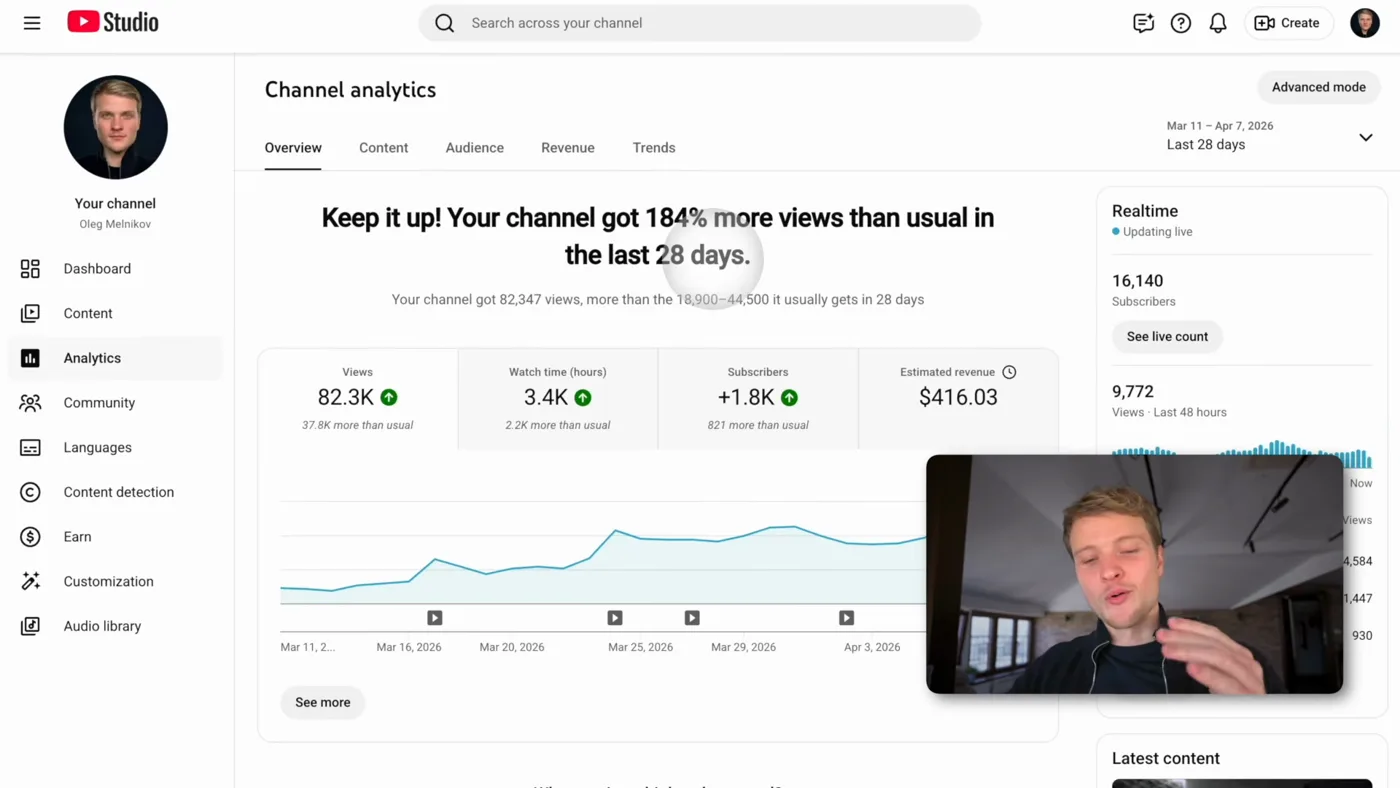
I asked Claude Code to analyse nearly 2,000 videos from my competitors, about 90 million views between them, and tell me what my niche actually rewards. It found over 400 outlier videos, and the result is a report I still open months later.
What is in it:
- Thumbnail analysis. Every thumbnail broken into its parts, with frequencies: what percentage have a face, which anchor elements repeat, which text overlays keep showing up in the winners.
- Title and hook patterns, pulled from the actual transcripts rather than from the titles alone.
- Niche trend lines. Which topics are rising, which have peaked, which are quietly stable.
- An underserved-topic chart. The most useful page in the whole thing, described below.
- Audience desires, ranked. What people in this niche actually want, in order.
- About twenty actions, ICE scored so you know what to do on monday.
- A what-to-avoid section, which caught a real mistake I had been making.
This is a month of work for a person. It is not a month of work for a machine that can read every transcript.
The ICE score, which is why it is usable
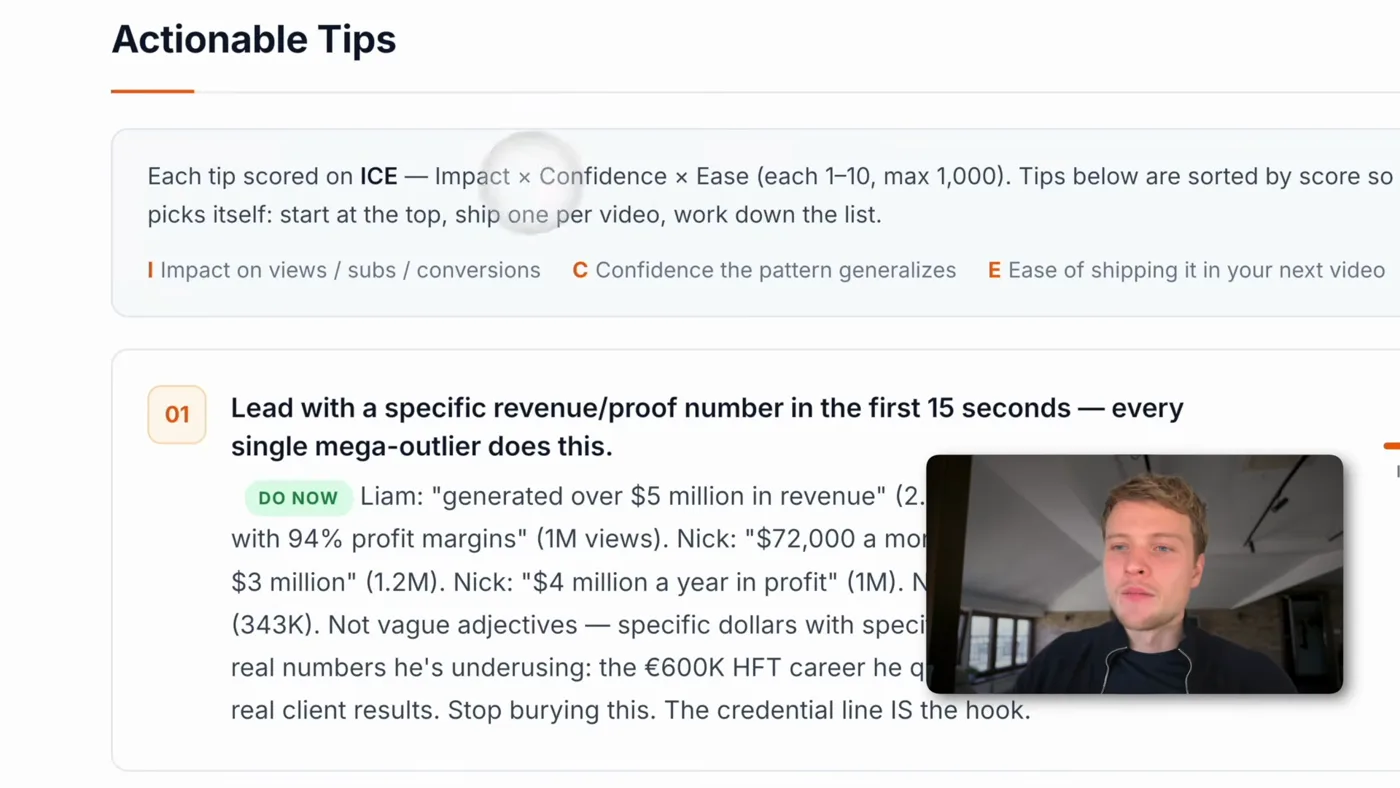
A report with twenty recommendations in it is a report you will not act on. So every action gets scored on three axes, one to ten, multiplied together:
- Impact
- Impact on views, subscribers and conversions
- Confidence
- How confident we are that the pattern generalises, rather than being one creator's quirk
- Ease
- How easy it is to ship in your next video
- Score
- The three multiplied, each rated 1 to 10, so 1,000 is a perfect ten on all three
The report's own wording. Tips are sorted by score, so the list picks itself: start at the top and ship one per video.
Multiplying rather than adding is the right call, because it punishes a zero. A brilliant idea you are not confident in, or that would take three months, drops down the list where it belongs.
The top item on my report scored 1,000, a perfect ten on all three. Here it is, because it is more useful than any description of the method:
Tip 01, scored 1,000
Lead with a specific revenue or proof number in the first 15 seconds. Every single mega-outlier does this.
The evidence it gave: "generated over $5 million in revenue" on a 2 million view video, "94% profit margins" on a million, "$72,000 a month", "$4 million a year in profit". Not vague adjectives. Specific dollars.
And then it turned that on me: I have real numbers I was underusing, and I was burying them. The credential line is the hook.
That is the shape of a good output. Not "improve your hooks", which is advice. A pattern, the evidence for it across several channels, and the specific thing I personally was getting wrong.
The underserved-topic chart
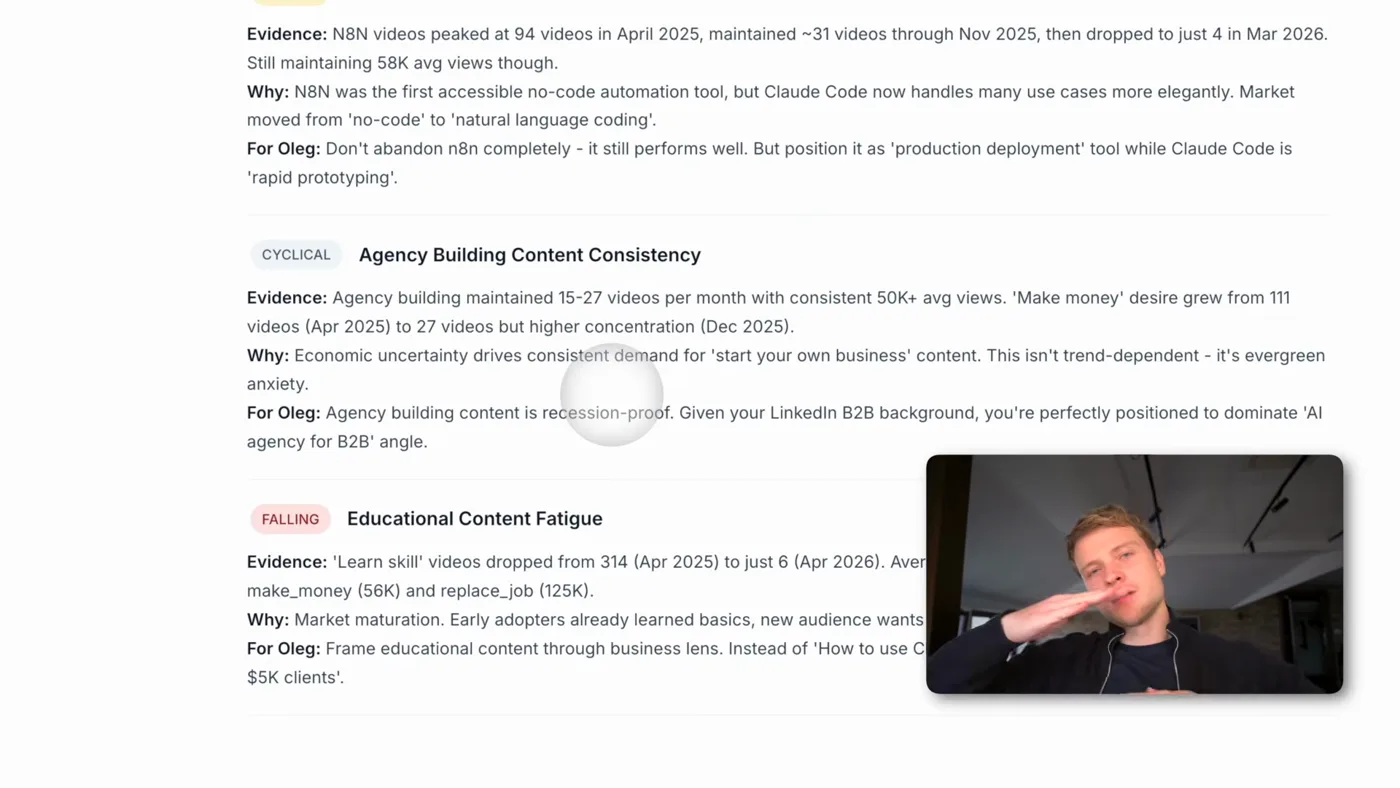
One chart plots average views against how many videos exist for each topic. The top-left corner, high demand and low supply, is where you want to be.
In my niche that surfaced whatsapp automation: people clearly want it and almost nobody was making it. That is a very different piece of information from "this topic is popular", because popular usually means crowded.
The reason this is hard to do by hand
You can feel which topics are popular. You cannot feel supply, because you only see what the algorithm shows you, and the algorithm shows you the crowded ones. Counting requires actually counting.
What your audience actually wants
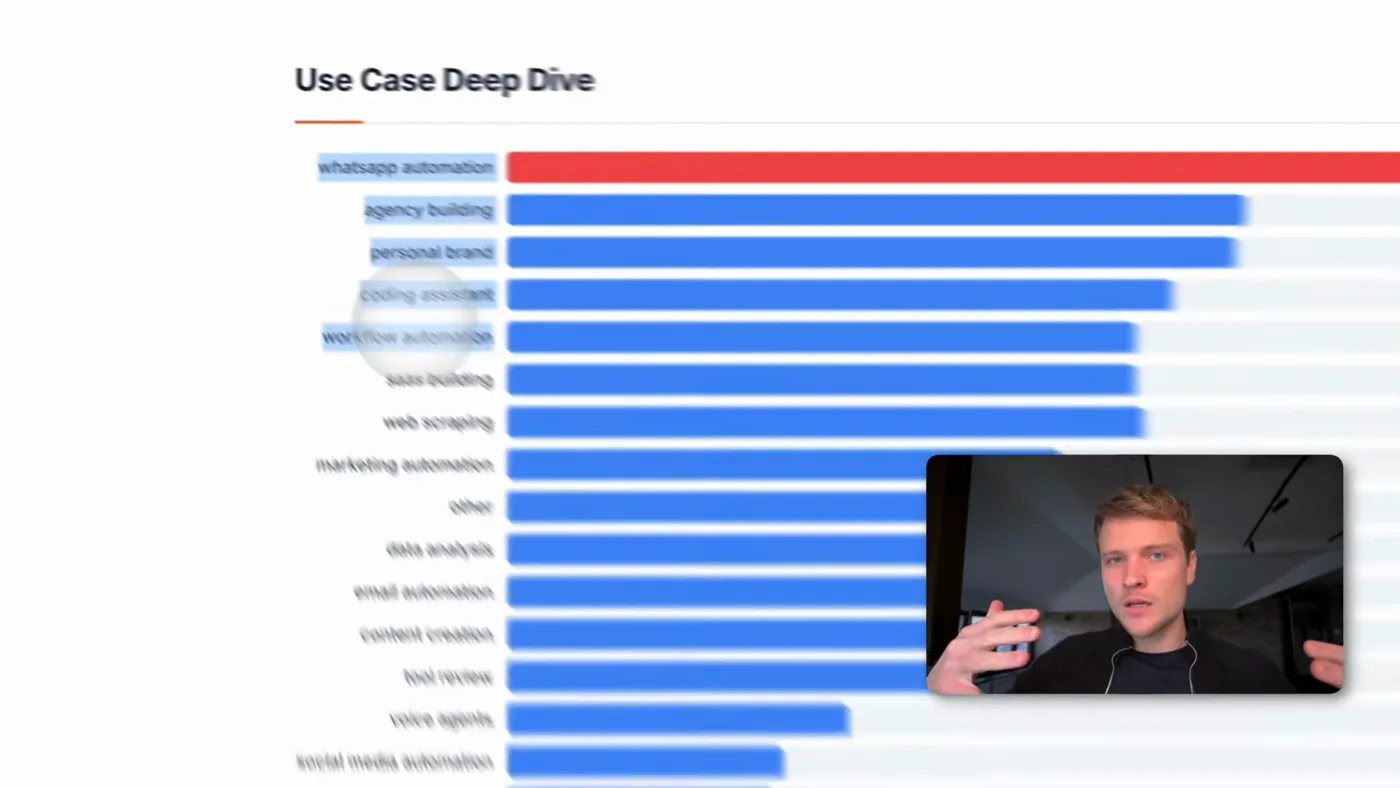
The report ranked the desires behind the searches in my niche. In order:
- Fear of being replaced. By a distance. This is the biggest driver in the AI niche and it is not close.
- Making money.
- Staying current.
- Saving time.
- Building something.
- Going viral. Last, which surprised me, since that is what half the content in this space is about.
It also split my audience into segments and weighted them, which is the part that changed what I film:
- 45% automation beginners looking for templates. The top videos there are template databases, and they have "free" in the title. Which is exactly the trap in the last section.
- 30% content creators wanting viral systems.
- 15% B2B marketers needing automation.
- 10% AI SaaS builders. And it noted that build vlogs consistently underperform for them.
Those are four different videos. Knowing which one you are making, and that the largest group is not the group you most want, is the difference between a video that works and one aimed at nobody in particular.
Building it
1List your competitors from your own subscriptions
I went through my own YouTube subscriptions and picked everyone serious in my niche. No clever sourcing. The accounts you already follow are the accounts you already judged worth following.
Give Claude Code the list and ask it to analyse every video they published in the last year. Mine came to nearly 2,000.
2Connect Apify and scrape everything, not just the numbers
Apify is what makes the depth possible. one API key in the project and claude code can pull youtube, tiktok, instagram, facebook and google trends.
Ask for the thumbnails and the transcripts, not just the view counts. This is the difference between a report about numbers and a report about why things worked. The transcripts are where the hook patterns are.
And do not ask Claude Code to scrape those sites directly. Platforms block it, so it half works and then breaks.
3Give it your own account too
This is the step that turns generic advice into advice. Give it your own channel, Instagram or LinkedIn and ask it to read every post you have made and how each one did.
It matters because the algorithm punishes going off topic. If I post the best fitness video ever made, it tanks, because my audience did not come for that. Advice that ignores who already follows you is advice for somebody else's account.
4Ask for outliers, not averages
The specific thing worth asking for: videos that performed far above average for their own channel. Mine found over 400 of them across nearly 2,000 videos.
A big channel's normal video tells you what a big channel gets. A video that beat its own channel by five times tells you something about the idea, and the idea is the transferable part.
5Ask for it as a report you can navigate
Ask for HTML with sections and charts. This is a document you will come back to for months, and a wall of terminal output is not that.
6Then iterate, out loud, about ten times
This is the whole ballgame and it has its own section below. The first report will be mediocre. Read it, tell it exactly what is wrong, run it again.
The secret that made it five times better
I have to be honest about this, because it is the part that gets left out of videos like mine. The first report was not good.
Some conclusions were wrong about my niche. More of them were things I already knew, said confidently, which is worse than useless because it feels like insight. I read it and thought: this is not it.
What got it to the version I still use was about ten rounds of feedback, dictated rather than typed. I read the report and talked back at it for a few minutes each round: this conclusion is wrong and here is why, go deeper on this channel, you have not understood my audience, that part is obvious, give me something better. Maybe thirty minutes of talking in total.
Why it needs you, put another way
If you asked the best operator you know for business advice, five minutes would get you nothing useful, because they do not know your situation. A day with them would change your business. The model is the same. It has the data and none of your context, and the only way to transfer context is to spend the time.
Dictate the feedback. A real round is five minutes of talking, and nobody types five minutes of nuance. That is the entire reason ten iterations took half an hour instead of an afternoon.
What to avoid, including one that cost me
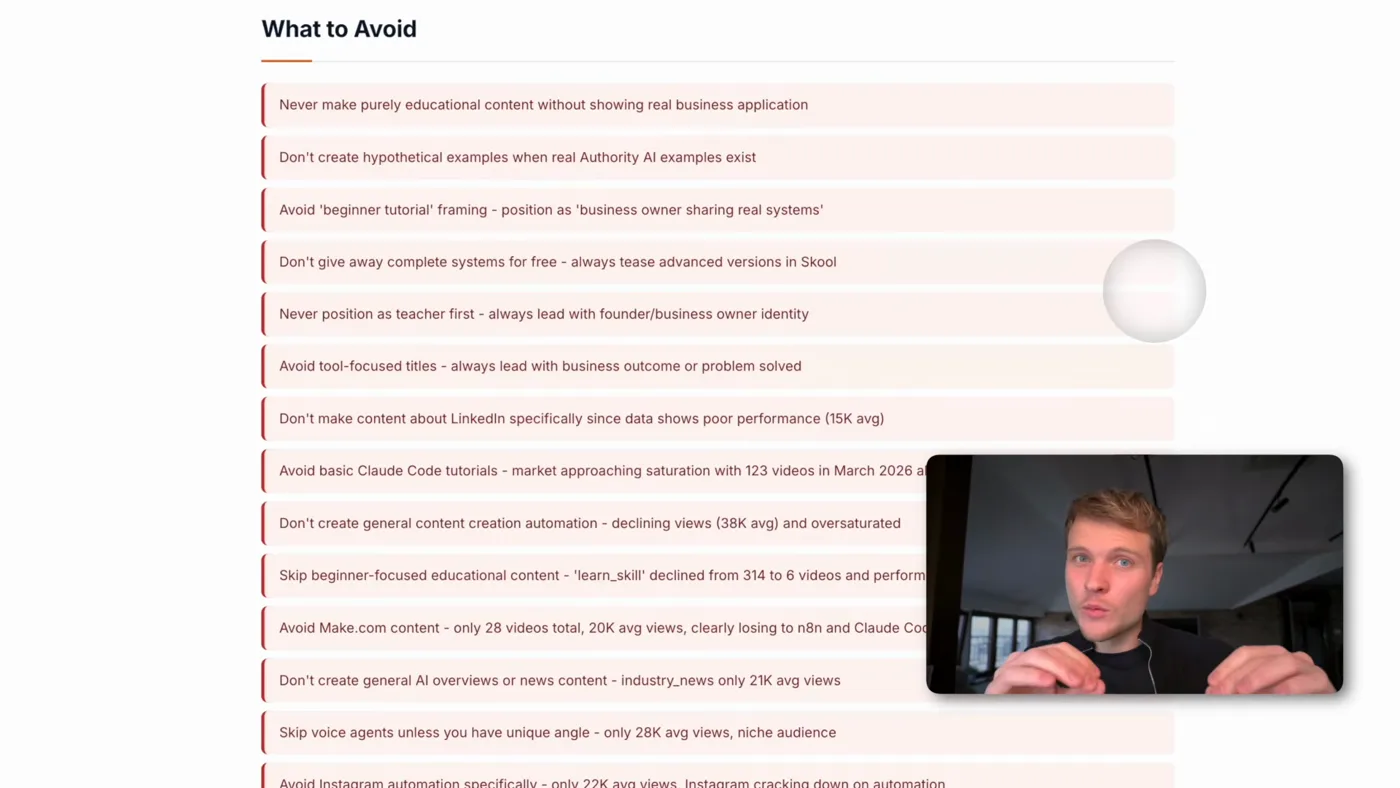
The report has a what-to-avoid section, and it caught something I had been doing wrong for months.
I had a video reach 95,000 views with the word "free" in the title and the thumbnail. Great number. It brought in an audience that was never going to buy anything, and it taught the algorithm to send me more of them. Claude's note was blunt: stop putting free in your titles, it builds the wrong association.
It was right, and I would not have worked it out on my own.
The general lesson, and the reason it found it:
- Tell the report what business outcome you want, not just that you want views. Views and revenue are different targets and sometimes they point in opposite directions.
- Give it your own numbers, so it can see which of your videos brought the right people rather than the most people.
- Ask what to stop doing. Reports default to suggestions. The subtractions are usually worth more.
Once you know what to make, the making half is on The content guide, and the short-video versions are on Reels and TikTok. Never used Claude Code? Start here, and This is what it costs.